Classification provided by the World Register of Marine Species (WoRMS). [827719]
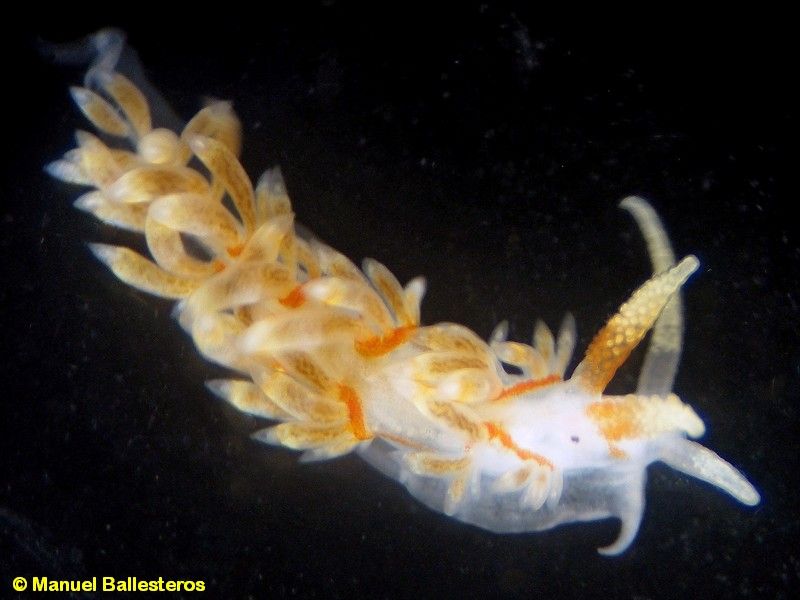
Description The body is elongate and slender, tapering gradually to the posterior end of foot. Body colour is translucent white with opaque bright white spots on the notum that is otherwise light brown due to the digestive gland inside. The pericardium is more or less covered by an orange mark (can be almost invisible or brightly coloured). Each side of the head has a boomerang-shaped orange patch, tapering gradually to the base of the oral tentacles. The oral tentacles are coloured brownish with iridescent white or pale yellow granulations colouring the tips. The rhinophores are orange in the basal part and become yellowish to the tip, which is white. The rhinophores are densely papillate on rear side, with papillae more or less rounded on posterior side, but elongate and perpendicular on the sides. The eyes are visible behind the base of the rhinophores. Oral tentacles are elongate and larger than the rhinophores. The cerata, slender and quite uniform in diameter throughout most their length, are coloured brownish with greyish translucent white pigmentation on the tips (round tipped in the original species description from Senegal, sharp tipped in the Mediterranean specimens). Inside them, the digestive gland is light brown and occupies almost the entire interior of the cerata. There is a thin subapical dull yellowish ring. Cnidosacs are white. Cerata are inserted to the body forming up to seven arches on each side of the body, extending from the back of the rhinophores almost to the posterior end of the foot. Each arch has between 3 and 20 cerata, decreasing in size towards the sides and towards the tail. There are orange lines following the inner borders of the ceratal insertions. The anus is located on the right side of the body, below the second ceratal arch. Genitalia is also located on the right side, among the cerata of the anterior-most group. The foot is broad and almost translucent, and on the anterior part it has well developed tentaculiform and also translucent propodial palps. The tail is long and sharp.
Biology Due to its recent description, little is known about its food, but like other species of the genus, it feeds on cnidaria. The eggstring is laid forming a 4 whorl anti-clockwise spiral of small white eggs.
Etymology
Marinae, named after Marina Poddubestkaia, who provided the authors several Aeolidiidae species from France.
Distribution Known only from Senegal (original description), from Mataró (Barcelona, Spain) where it becomes the first report for the Mediterranean Sea and from Granada (Spain), where it was found in july 2025.
Known georeferenced records of the species: Berghia marinae
Sources:
OBIS
GROC 2010-2011
Enric Madrenas
João Pedro Silva
Bernard Picton
GBIF
OPK
VIMAR
Manuel Ballesteros
M@re Nostrum
Altres fonts
Marine Regions
Similar species Berghia marinae is clearly distinguishable from other members of the genus by its coloration. Only B. stephanieae may have similar colouration of the cerata, but it lacks the orange lines on the ceratal insertions found in B. marinae and also has a completely different ceratal arrangement and geographical distribution. The specimen found on the Spanish coast of Mataró shows a different colouration pattern compared to the original description of B. marinae from Senegal, externally resembling B. columbina, however, the molecular phylogenetic hypothesis supports the validity of B. marinae. This could be due to an ecological adaptative approach in which the strategy used by the Senegal population is to live unnoticed, while the Mediterranean population, with its vivid colours, warns its predators in the same way as B. columbina (see Galià-Camps et al., 2020, p.196-197).
Abundance
Western Mediterranean:
★☆☆☆☆
Eastern Mediterranean:
☆☆☆☆☆
Atlantic Ocean:
★☆☆☆☆
Month
This chart displays the monthly observation probability for Berghia marinae based on our own records.
Ballesteros, M., Pontes, M., Madrenas, E. (2019). Els nudibranquis del mar català. Brau Edicions.
Ballesteros, M., Madrenas, E., Pontes, M. (2026). OPK - Opistobranquis. Disponible en: https://opistobranquis.info/ [Accedido 6 de marzo de 2026]
Carmona, L., Pola, M., Gosliner, T. M., Cervera, J. L. (2014). The atlantic-mediterranean genus Berghia Trinchese, 1877 (Nudibranchia: Aeolididiidae): taxonomic review and phylogenetic analysis. Journal of Molluscan Studies, 80: 482-498.
Edmunds, M. (2015). Opisthobranchiate Mollusca from Ghana, Aeolidiidae, with consideration of several caribbean species. Journal of Conchology Vol. 42(2): 125-161.
Galià-Camps, C., Carmona, L., Cabrito, A., Ballesteros, M. (2020). Double trouble. A cryptic first record of Berghia marinae Carmona, Pola, Gosliner & Cervera 2014 in the Mediterranean Sea. Mediterranean Marine Science, 21(1), 191-200. https://doi.org/10.12681/mms.20026
Pontes, Miquel, Manuel Ballesteros, Enric Madrenas (2025) "Berghia marinae" in OPK-Opistobranquis. Published: 06/12/2020. Accessed: 17/08/2026. Available at (https://opistobranquis.info/en/?p=30949)